
 Shop now, pay later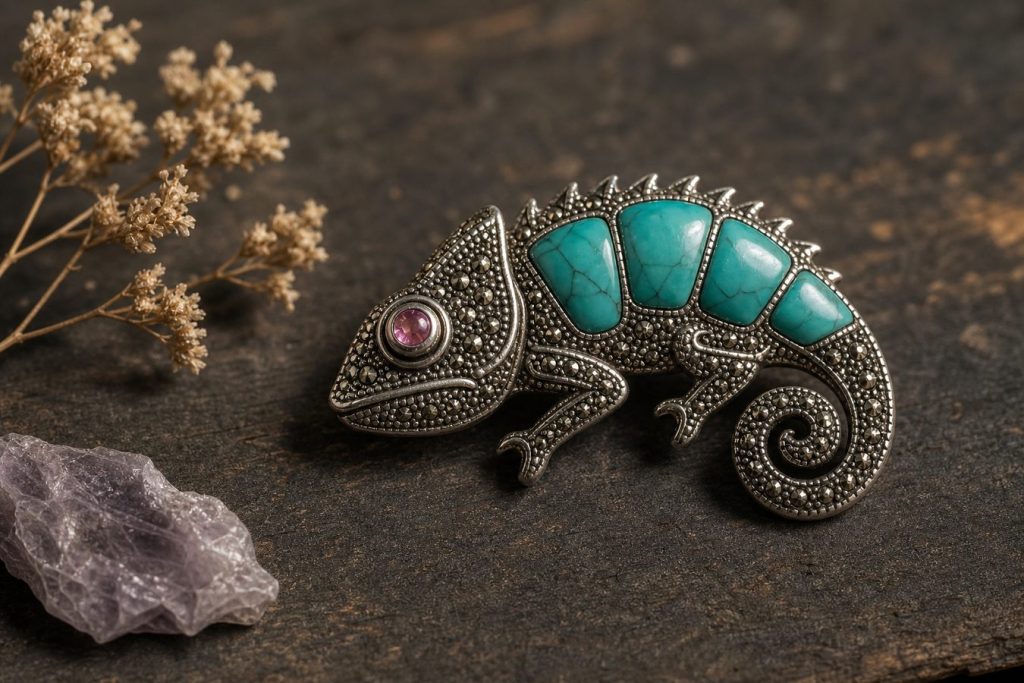
Natural turquoise jewelry has held its place in Southwestern silverwork for over a century, and shoppers in 2026 still ask the same core question: how do I know the stone is real? This guide covers origin, hardness, treatments, and setting quality so you can buy with confidence.
At SilverRush Style, we have sold sterling silver jewelry set with natural stones since 2005. The notes below reflect what we look for when sourcing genuine turquoise for rings, pendants, earrings, and cuffs.
What Makes Turquoise “Natural”
Turquoise is a hydrated copper aluminum phosphate with the formula CuAl6(PO4)4(OH)8·4H2O. Its color comes from copper (blue) and iron (green), and the dark veining, called matrix, is host rock such as limonite, pyrite, or quartz. Mohs hardness ranges from 5 to 6, softer than quartz, which is why settings and daily wear matter.
“Natural” in the trade means the stone has been cut and polished but not chemically altered. “Stabilized” turquoise is real turquoise infused with clear resin to harden porous material; it is still genuine, just treated. Avoid “reconstituted,” “block,” or dyed howlite, which are not turquoise at all.
A quick field check: real turquoise feels cool to the touch, shows irregular matrix patterns, and never has a plastic seam. Price is another signal, since high-grade natural stones from named mines rarely sell for a few dollars per carat.
Mines and Regional Character
Southwestern turquoise jewelry gets much of its identity from specific mine sources. Each deposit produces a recognizable color range and matrix pattern, and mine names carry weight because most historic mines are now closed or nearly depleted.
American Mines to Know
- Sleeping Beauty (Globe, Arizona): clean robin’s-egg blue with little to no matrix. The mine closed to turquoise production in 2012, so remaining rough is limited.
- Kingman (Mineral Park, Arizona): bright blue with black or pyrite matrix, one of the few large mines still active.
- Royston (Nevada): blue-to-green color shifts within a single stone, brown host rock matrix.
- Number 8 (Eureka County, Nevada): spiderweb matrix, mined out since 1976 with rare rediscovered pockets.
- Cloud Mountain and Golden Hill: often marketed as Southwestern-style but sourced from China and Kazakhstan respectively; still natural turquoise, just not American.
Iranian (Persian) turquoise from the Nishapur region has been mined for more than 2,000 years and is prized for uniform sky-blue color. Chinese Hubei turquoise supplies a large share of the current global market and offers strong greens and blues at accessible prices.
Judging Quality and Setting
Grading turquoise is not standardized the way diamond grading is, but four factors drive value: color saturation, matrix pattern, hardness of the specific stone, and cut symmetry. High-grade natural stones ring above 5 on the Mohs scale and take a glassy polish without wax coating.
Setting quality matters just as much as the stone. Look for bezel cups that fully support the girdle of the cabochon, solid sterling silver marked 925, and clean solder joints on bezels, wire work, and jump rings. Our sterling silver jewelry collections use .925 silver, which contains 92.5% pure silver alloyed with 7.5% copper for structural strength.
For rings worn daily, choose lower-profile bezels and stabilized stones, which resist knocks and skin oils better than untreated high-grade rough. For pendants and earrings that avoid impact, natural untreated stones from named mines make sense and hold their value over time.
Care and Everyday Wear
Turquoise is porous and reactive. Perfume, hairspray, sunscreen, chlorinated pool water, and household cleaners can shift its color from blue toward green or dull the polish. The rule most collectors follow: turquoise goes on last and comes off first.
Clean pieces with a soft, dry cloth or a barely damp cotton pad. Skip ultrasonic cleaners, steam, and commercial silver dips, all of which can strip stabilization resin or crack natural fissures. To brighten the sterling silver setting, use a polishing cloth designed for .925 silver and work around the stone, not across it.
Store each piece in a separate soft pouch or a lined compartment. Silver tarnishes faster in humid air, so anti-tarnish strips inside a closed box slow oxidation. If a natural stone shifts color slightly over years of wear, that patina is expected and does not indicate a fake.
Buying Checklist Before You Add to Cart
Ask for the mine name or country of origin, whether the stone is natural or stabilized, and confirmation the metal is stamped 925. Reputable sellers list these details on the product page or provide them on request. Photographs should show matrix clearly, not just a filtered hero shot.
Compare pricing against the stone’s carat weight and mine reputation. A large Sleeping Beauty cabochon in a heavy silver cuff will not sell at costume-jewelry prices, and a very cheap “Persian” stone likely is not Persian. Trust sellers who explain treatments openly rather than avoiding the word.
If you are ready to browse natural turquoise pieces set in .925 silver, our SilverRush Style catalog lists mine origin and treatment where known. Reach out with questions before you buy; we would rather match you with the right stone than send back a return.