
 Shop now, pay later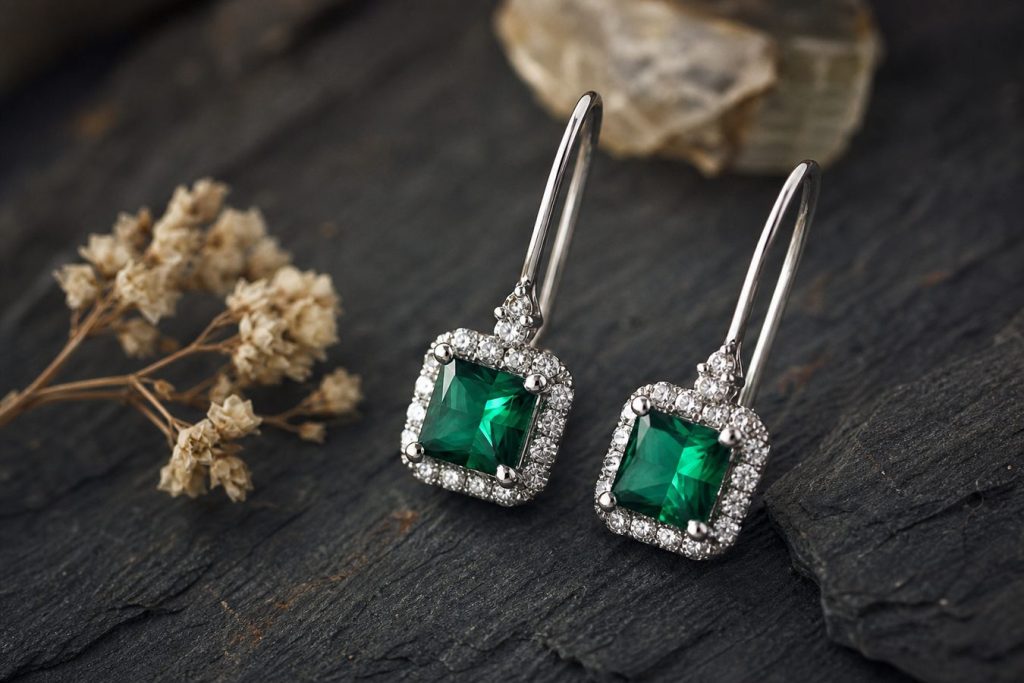
A real emerald jewelry set gives you a matched ring, pendant, and earrings cut from natural beryl rather than lab glass or dyed quartz. At SilverRush Style, we’ve built sets around genuine emeralds since 2005, and the questions we hear most are about origin, hardness, and how to tell a natural stone from a treated one. This guide walks you through what actually matters before you buy.
What Makes an Emerald Set “Real”
Emerald is the green variety of beryl, a beryllium aluminum silicate with the formula Be₃Al₂Si₆O₁₈. Its color comes from trace chromium, and sometimes vanadium, inside the crystal lattice. Without those trace elements, the same mineral would be aquamarine or morganite.
Natural emeralds sit at 7.5 to 8 on the Mohs hardness scale. That is softer than sapphire or diamond, and it explains why nearly every emerald on the market has internal fissures called jardin, French for garden. A stone with zero inclusions under 10x magnification is almost always synthetic or glass.
Most natural emeralds are also treated with cedarwood oil or a clear resin to fill surface-reaching fractures and improve clarity. This is an accepted trade practice, disclosed by reputable sellers, and graded as minor, moderate, or significant. A real set can include treated stones; what matters is that the treatment is disclosed and the base material is genuine beryl.
Origin and Color Grading
Colombia produces the emeralds most collectors rank highest, particularly from the Muzo, Chivor, and Coscuez mines in the Boyacá department. Colombian stones tend toward a pure, slightly bluish green with strong saturation. Zambia’s Kagem mine is the second major source and yields cooler, more bluish greens with fewer inclusions on average.
Brazil, Ethiopia, and Afghanistan also supply the market, each with its own color signature. A jeweler who can name the mine region, not just the country, is giving you information you can verify against GIA and Gübelin lab reports.
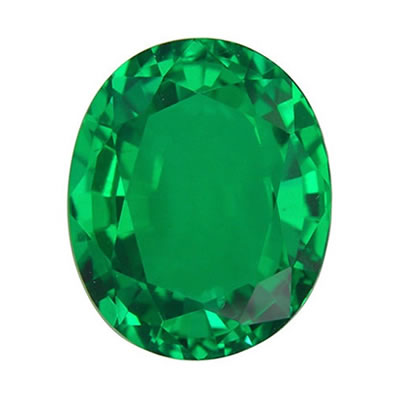
Color is graded on hue, tone, and saturation. The target for fine emerald is a medium to medium-dark tone with vivid saturation and a green to slightly bluish-green hue. Stones that look pale, gray, or yellowish sell for a fraction of the price, so match the grade to your budget rather than chasing a label.
Carat Weight Across a Set
In a matched set, the center emerald in the ring is usually the largest, followed by the pendant, with smaller accents in the earrings. A balanced three-piece set often totals 2 to 5 carats of emerald. Ask for individual stone weights, not just the aggregate, because two 0.5-carat earring stones cost far less than one 1-carat ring center of the same quality.
Choosing the Metal and Setting
Sterling silver, marked 925, contains 92.5 percent silver and 7.5 percent copper or other alloy metals. It is the most common metal for our emerald jewelry because it keeps the cost proportional to the stone rather than the mounting. White gold and platinum also flatter the green, while yellow gold warms the color and reads more traditional.
Bezel and halo settings protect the girdle of the emerald, which is the part most likely to chip on impact. Prong settings show more of the stone but leave the edges exposed, so they suit pendants and earrings better than daily-wear rings. If you plan to wear the ring often, ask about a low-profile bezel or a protective halo of white topaz or diamond accents.
Check the finish inside the mounting too. A polished interior means the setter took time on the parts you don’t see, which usually correlates with better prong work on the parts you do. Our full range of sterling silver jewelry is finished this way, and the same standard applies across our emerald sets.
Care, Cleaning, and Verification
Never put emeralds in an ultrasonic or steam cleaner. Both can drive out the oil or resin used to stabilize fractures, leaving the stone looking cloudy and revealing internal cracks that were previously invisible. Warm water, mild dish soap, and a soft toothbrush are the safe method.
Store each piece of the set separately in a soft pouch or lined box. Emerald’s hardness protects it from most household scratches, but harder gems like diamond, sapphire, and topaz will scratch emerald if they rub together in a drawer. Re-oiling every few years, done by a bench jeweler, restores clarity for stones that have dried out.
How to Verify Before You Buy
Ask three questions of any seller. First, is the emerald natural or synthetic, and if natural, what is the country and mine region. Second, what treatment has been applied, and at what grade. Third, is a lab report available for stones over one carat, and if not, will the seller stand behind an independent appraisal after purchase.
A seller who answers all three directly is giving you a real set. A seller who deflects, uses vague terms like “genuine gemstone” without naming the species, or refuses appraisal is not. The paperwork is as much a part of the purchase as the jewelry itself.
Building Your Set
You can buy a matched three-piece set at once or build it over time by starting with a pendant, adding earrings, then the ring. Building in stages lets you upgrade stone quality as your budget grows, and it spreads the cost across birthdays or anniversaries. May birthstone gifts and 20th and 55th wedding anniversaries are the traditional occasions for emerald.
If you’d like help matching stones across pieces or sourcing a specific origin, our team can pull options from current inventory and share stone photos before you commit. Reach out with your budget and target color, and we’ll show you what’s actually in stock.