
 Shop now, pay later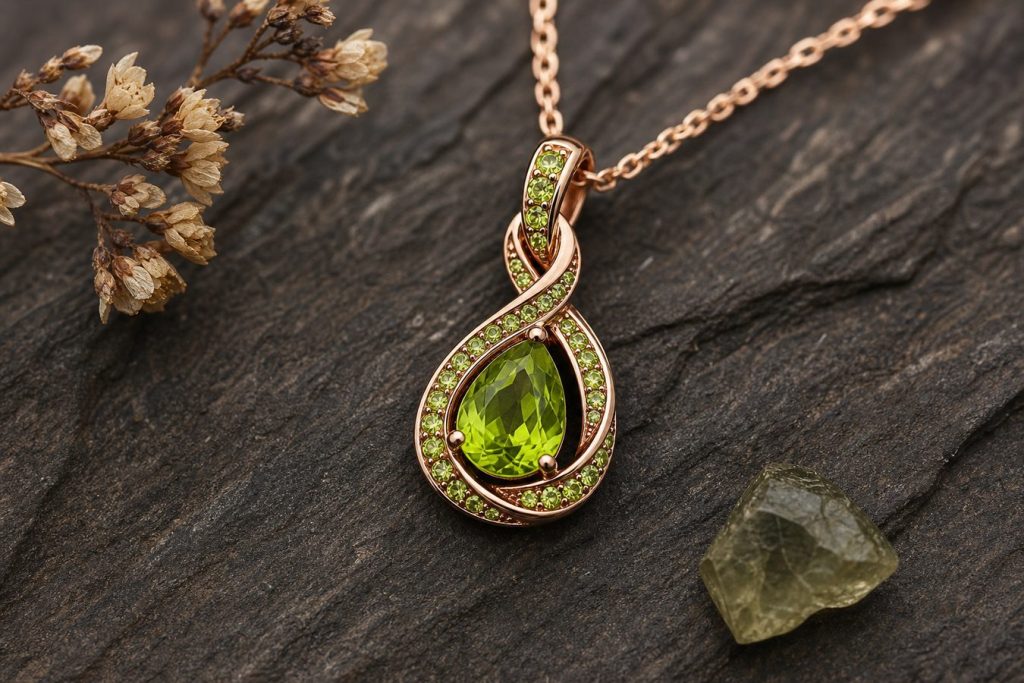
August birthstone jewelry has one signature look: the yellow-green glow of peridot. If you’re shopping for an August birthday, an anniversary, or a summer gift, peridot pairs well with warm skin tones and looks especially clean set in sterling silver. This guide covers the stone’s background, what to check before you buy, and how to care for it once it’s in the jewelry box.
What Is the August Birthstone?
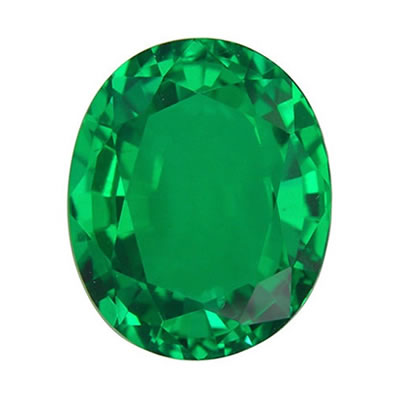
Peridot is the modern August birthstone, recognized by the American Gem Trade Association and Jewelers of America. It’s the gem variety of the mineral olivine, with a chemical formula of (Mg,Fe)₂SiO₄, meaning its color comes from iron content within the crystal itself rather than from trace impurities.
The stone measures 6.5 to 7 on the Mohs hardness scale, which puts it below sapphire and quartz but above opal. That range makes peridot suitable for daily wear in earrings and pendants, though rings need a protective setting to guard against knocks.
Sardonyx and spinel are sometimes listed as alternate August birthstones, but peridot remains the most popular choice for jewelry marketed under the August category.
Where Peridot Comes From
Historic sources include Zabargad Island in the Egyptian Red Sea, mined for more than 3,500 years. Modern commercial peridot comes mostly from Peridot Mesa in San Carlos, Arizona, along with deposits in Myanmar (Burma), Pakistan’s Kashmir region, and China.
Arizona peridot tends toward yellowish-green in smaller sizes, while Burmese and Pakistani material can reach a deeper olive tone in larger carat weights. Very rare peridot samples have also been recovered from pallasite meteorites, though gem-quality meteoritic peridot rarely reaches retail.
Choosing an August Birthstone Necklace Gift
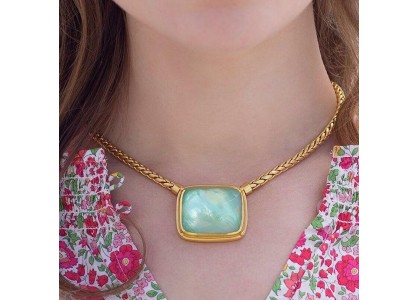
An August birthstone necklace gift works well for birthdays, Mother’s Day, or a first anniversary, since peridot carries no color associations that clash with most wardrobes. Look for a pendant between 6mm and 10mm for daily wear; anything larger reads as evening jewelry and gets worn less often.
Check the setting first. A bezel setting protects the girdle of the stone and hides small chips, while a prong setting shows more of the pavilion and lets light pass through for a brighter face-up color.
Color grade matters more than clarity with peridot. The most desirable shade is a pure grass-green with minimal yellow or brown; heavily included stones under 2 carats are still considered acceptable if the color is even.
Matching Peridot to Metal
Peridot’s yellow-green cast reads clean and cool against white metals, which is why sterling silver jewelry is a common pairing. The .925 alloy reflects light back through the stone without pushing the color warm the way yellow gold does.
If the recipient wears mostly silver, stick with silver settings for the birthstone piece so it stacks with what she already owns. For someone who wears mixed metals, a silver chain with a peridot pendant bridges both looks without committing to one palette.
Peridot Sterling Silver Jewelry: What to Check
Peridot sterling silver jewelry should carry a .925 stamp on the clasp, bail, or inside the ring shank. That stamp confirms the metal is 92.5% pure silver alloyed with 7.5% copper, which is the international standard for sterling.
Ask whether the peridot is natural or synthetic. Most peridot on the market is natural because lab-grown olivine costs nearly as much to produce as mined material, but disclosure still matters for resale value and honest gifting.
Inspect the stone under a bright light for eye-visible inclusions called “lily pads,” which are small disc-shaped fractures common in peridot. A few are normal and don’t affect durability, but a stone with fractures reaching the surface should be avoided for rings.
Care and Cleaning
Peridot is sensitive to sudden temperature changes and acidic cleaners. Skip ultrasonic and steam cleaners, and never soak peridot in jewelry dip solutions, which can etch the surface over time.
Clean with warm water, a drop of mild dish soap, and a soft toothbrush. Dry with a lint-free cloth and store peridot pieces separately from harder gems like diamond, sapphire, or topaz to prevent scratches on the table facet.
Sterling silver settings will tarnish with air and skin oils; a polishing cloth restores shine in about a minute. Store finished pieces in an anti-tarnish pouch when they’re not being worn to slow oxidation.
Peridot Jewelry Styles That Wear Well
Stud earrings in 5mm to 7mm sizes are the most versatile entry point for August birthstone jewelry. They pass under hair, work at the office, and don’t compete with a necklace or ring already in rotation.
Solitaire pendants on an 18-inch cable chain sit at the collarbone and layer cleanly with longer chains. For rings, halo settings surrounding a central peridot with white cubic zirconia or white topaz add sparkle without changing the green core color.
Bracelets with peridot stations spaced along a silver link chain give the stone room to catch light from multiple angles as the wrist moves. This style suits recipients who already own studs and want something less predictable than a matching pendant.
If you’re ready to shop peridot pieces set in .925 silver, browse the August birthstone collection at SilverRush Style and filter by pendant, ring, or earring to narrow the selection. Message our team if you need help matching a chain length or ring size before ordering.